Self-Check, Bump Test, or Calibration—What's the Real Difference?
Tests You Need to Know for Gas Detector Safety
When Was the Last Time You Really Tested Your Detector?
In our daily conversations with customers, we've noticed that many people are unclear about these three concepts. Some assume that if the self-check passes, everything is fine. Others confuse bump tests with calibration.
Today, we'll break down the differences so you can use your gas detector with greater confidence and clarity.
Let's Start with Some Real-World Scenarios
Scenario 1
A factory used their carbon monoxide detectors daily. Every morning, the self-check showed "OK." During annual maintenance, they discovered that the intake ports were completely clogged with contaminants—gas could barely diffuse into the sensors. The self-check had never detected this issue.
Scenario 2
A user reported: "Today at work, the fixed CO₂ detectors in our workshop all alarmed, but my portable CO₂ detector didn't react. And my unit was just calibrated last month." Inspection revealed the CO₂ sensor had failed entirely. No bump test had been performed, so the failure went unnoticed until an actual incident occurred. Fortunately, quick response prevented any loss.
Scenario 3
An environmental monitoring agency had been using the same detector for two years of data collection. When they later compared their readings against reference values, they found a 30% deviation. Looking back, the device hadn't been calibrated in 18 months.
These situations aren't rare in our industry. Understanding the differences between self-check, bump test, and calibration is essential for proper equipment use and achieving true safety in gas detection.
01
Self-Check: The Basic Startup Test
A self-check is the device's internal diagnostic routine, typically performed automatically at startup. It verifies basic electrical continuity and hardware functions—things like battery connection, battery level, audible/visual/vibration alarm functionality, display, and pump operation (if equipped).
When a self-check passes, it simply means the device powers on normally. It does not confirm detection capability. That requires actual gas exposure.
Think of it this way: A self-check is like your car's dashboard lights coming on when you start the engine. It tells you the electrical system is working—but not whether the wheel bearings are worn or the alignment is off. You still need to perform manual checks.
02
Bump Test: Functional Verification with Gas
A bump test (also called a gas test) is a quick functional check. The detector is briefly exposed to a known concentration of calibration gas to confirm:
The sensor responds to the target gas
The display correctly shows gas concentration readings
Audible, visual, and vibrating alarms function properly
Passing standard: The detector must alarm within a specified time (typically 40-60 seconds) after gas exposure.
When to do it: Industry safety standards recommend a bump test before each entry into a hazardous area. This quick functional check confirms the device is "effective today."
Why a self-check isn't enough: A self-check won't tell you if a sensor has lost sensitivity or if the inlet is blocked. Only actual gas contact can validate that the detection function is working properly
03
Calibration: Precision Adjustment)
Calibration is the process of using a known concentration of calibration gas to test and adjust the detector's readings, bringing them into alignment with the true gas concentration.
Why calibration is necessary:
Over time, sensors gradually "drift"—sensitivity changes due to aging, environmental conditions, and usage frequency. A drifted sensor may still respond to gas, but its readings may be inaccurate. Calibration restores measurement accuracy.
What calibration includes:
Zero calibration: Adjusting the reading to zero using gas with zero target gas concentration (typically pure nitrogen; clean air is often considered zero gas for toxic gases like H₂S, CO, and SO₂)
Span calibration: Testing and adjusting the reading using a known concentration of calibration gas to match the expected value
When to do it: Generally recommended every 3-6 months, depending on usage environment, sensor type, and manufacturer recommendations. If a bump test fails, immediate calibration is required.
Think of it this way: After running for a month, your mechanical watch is 2 minutes slow. You wind it and adjust the time to match the standard.
04
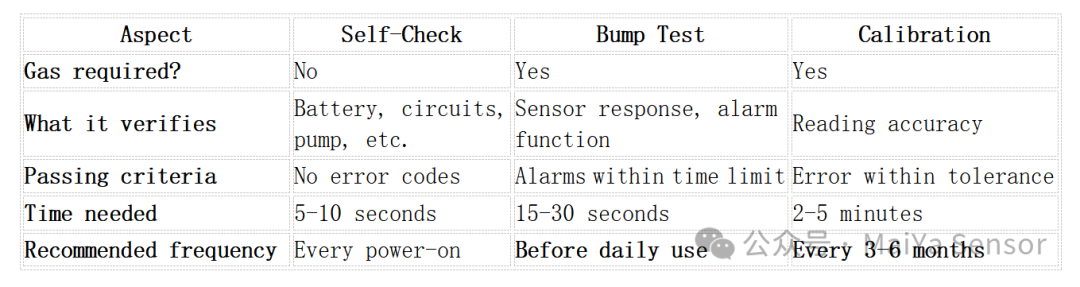
At a Glance: Key Differences
05
How They Relate
Think of it this way:
Self-check is the foundation—it tells you the device "powers on normally."
Bump test is the assurance—it tells you the device is "effective today."
Calibration is the foundation of accuracy—it tells you the device "measures correctly."
Each serves a distinct purpose; none replaces the others. A passed self-check doesn't guarantee a passed bump test, and a passed bump test doesn't guarantee accurate readings.
 Hot News
 EN
EN
 CH
CH AR
AR BG
BG DA
DA NL
NL FR
FR DE
DE EL
EL HI
HI IT
IT JA
JA KO
KO PL
PL PT
PT RO
RO RU
RU ES
ES SV
SV TL
TL IW
IW ID
ID LV
LV UK
UK VI
VI TH
TH TR
TR FA
FA MS
MS SW
SW GA
GA BE
BE UR
UR BN
BN MY
MY SI
SI KU
KU